
EU lowers Russian oil price ceiling and US reduces Saudi crude oil imports – new focus of energy landscape
- January 15, 2025
- Posted by: Macro Global Markets
- Category: News

Recently, there have been two significant changes in the global energy market: first, six EU countries called for a reduction in the price ceiling for Russian oil from the Group of Seven; second, the amount of crude oil imported by the United States from Saudi Arabia fell to the lowest point in nearly 40 years. These two events not only reflect the dynamic adjustment of the energy market, but also reveal the profound changes in the geopolitical landscape.
Sweden, Denmark, Finland, Latvia, Lithuania and Estonia jointly wrote to the European Commission, calling for a reduction in the $60 per barrel price cap set by the Group of Seven for Russian oil. These countries believe that lowering the price cap will further reduce Russia’s oil export revenue, thereby weakening its financial support in the Russia-Ukraine conflict, while not causing a shock to the market.
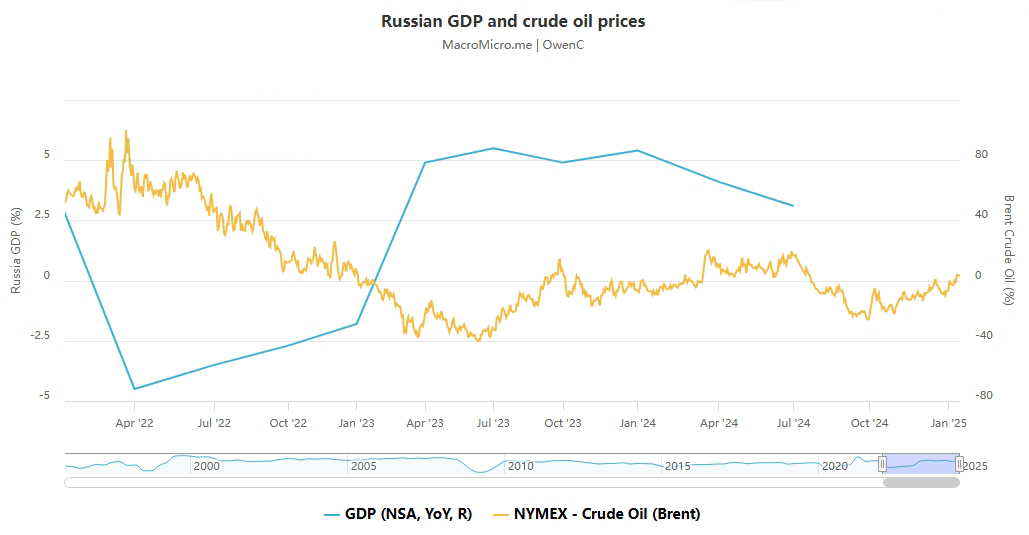
The G7 has previously set a price cap on Russian seaborne crude oil and refined oil products, aiming to limit Russia’s income from oil trade. Specifically, the price cap for Russian crude oil is $60 per barrel, $100 per barrel for high value-added refined oil products, and $45 per barrel for low value-added refined oil products. Andrei Yermak, chief of staff to Ukrainian President Zelensky, stressed that energy exports are the main source of funds for Russia to finance the conflict, and that oil prices are directly related to Russia’s military capabilities. Lowering oil prices will help promote the peace process.
Since the implementation of the price cap in December 2022 and February 2023, the average market price of Russian crude oil has been below this cap. The six EU countries pointed out in the letter that the current international oil market supply is good and the risk of supply shocks caused by lowering the Russian oil price cap has been significantly reduced. In addition, given Russia’s limited storage capacity and over-reliance on energy export revenues, it will be difficult for Russia to stop oil exports even if the price cap is significantly reduced.
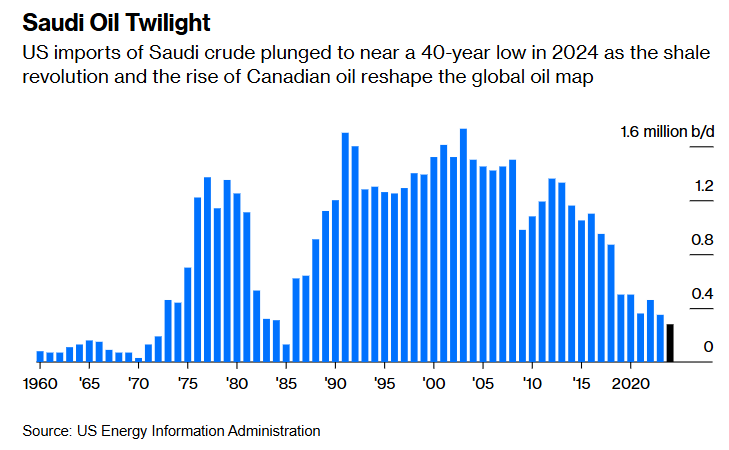
Meanwhile, U.S. crude oil imports from Saudi Arabia fell to their lowest point in nearly 40 years in 2024, a change that signals the waning influence of Saudi crude in the United States. The United States buys only about 277,000 barrels of Saudi crude per day, down nearly 85% from the record 1.73 million barrels per day in 2003, according to Bloomberg calculations based on customs data. The trend dates back to 1985, when Saudi Arabia tried to push up oil prices by cutting production, leading to a brief drop in imports. To find consecutive years of similarly low imports, you need to go back to the late 1960s.
The U.S. shale revolution and the rise of Canada’s oil industry are the main reasons for the decline in imports. The three largest U.S. refiners – Marathon Oil, Valero Energy and Exxon Mobil – have stopped importing Saudi crude oil in the past two years or so. Exxon’s last purchase of Saudi crude oil was in November 2023, indicating that the companies did not renew their long-term contracts, ending a decades-long relationship.
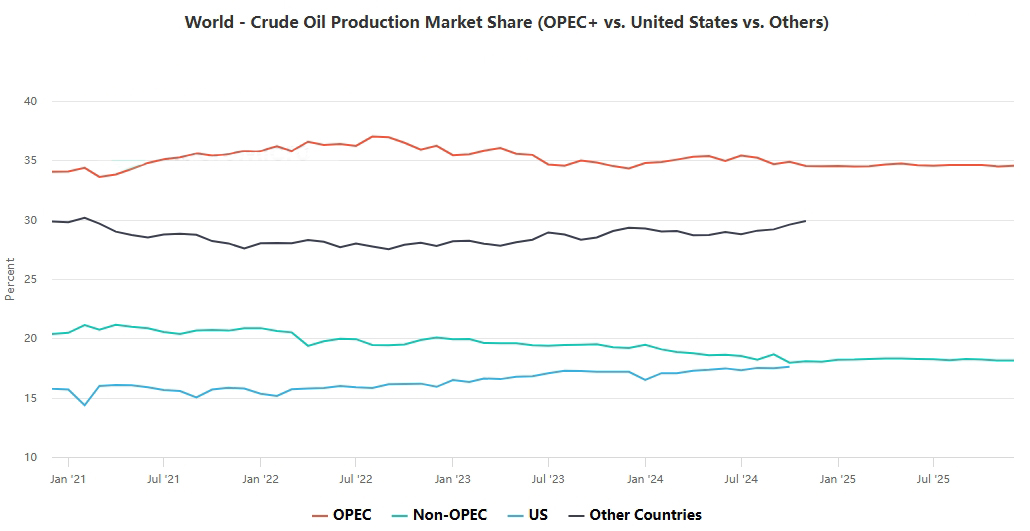
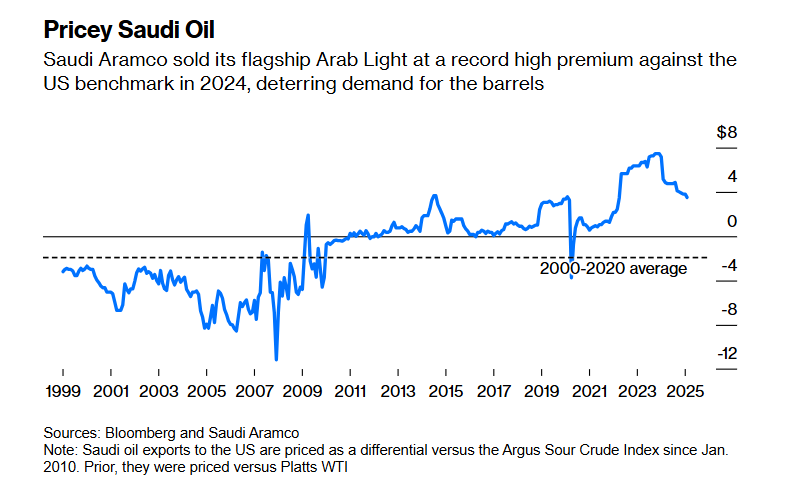
Still, Saudi Arabia remains a powerful geopolitical force that can influence gasoline prices in the U.S. by adjusting production. As a globally traded, fungible commodity, Saudi Arabia’s actions still have an impact in the U.S. However, the decline in U.S. crude oil imports from Saudi Arabia is not entirely the result of the shale revolution. Saudi Arabia deliberately prices its oil out of the U.S. market by charging U.S. refiners a very high premium for each barrel of oil they produce.
Riyadh set the premium for its flagship export product, Arab Light, at $5 a barrel above the U.S. sales reference price for most of 2023 and 2024, well above historical levels. Saudi Arabia uses its official selling price as a tool to reduce the kingdom’s oil inventories, which are closely watched by traders, by reducing oil flows into the United States. Therefore, low Saudi-U.S. flows become part of OPEC+ production cuts. Although these two events seem independent, they are actually two sides of the changing global energy landscape. On the one hand, the call by the six EU countries to lower the Russian oil price ceiling reflects Europe’s efforts to diversify its energy supply and reduce its dependence on Russian energy.
On the other hand, the United States’ reduction in Saudi crude oil imports shows significant progress in the United States’ energy self-sufficiency and the adjustment of its foreign policy in the Middle East. From a broader perspective, both events reflect the shift of the global energy market from traditional supply dependence to diversification and self-sufficiency. Both the EU and the United States are working to reduce their dependence on a single energy supplier and enhance their own energy security. This trend not only affects the supply and demand relationship in the international energy market, but also has a profound impact on the geopolitical strategies of relevant countries.
The EU six countries’ call for lowering the Russian oil price ceiling and the US’s reduction of Saudi crude oil imports reflect the dual changes in the global energy landscape. These changes not only affect the supply and demand relationship in the international energy market, but also have a profound impact on the geopolitical strategies of relevant countries. With the continuous adjustment of the energy market, countries will continue to seek a balance between energy security and geopolitical interests, and promote the global energy landscape to develop in a more diversified and stable direction.





 English
  Chinese
  Vietnamese